
The "diamond problem" (multiple inheritance issue) - Case Study

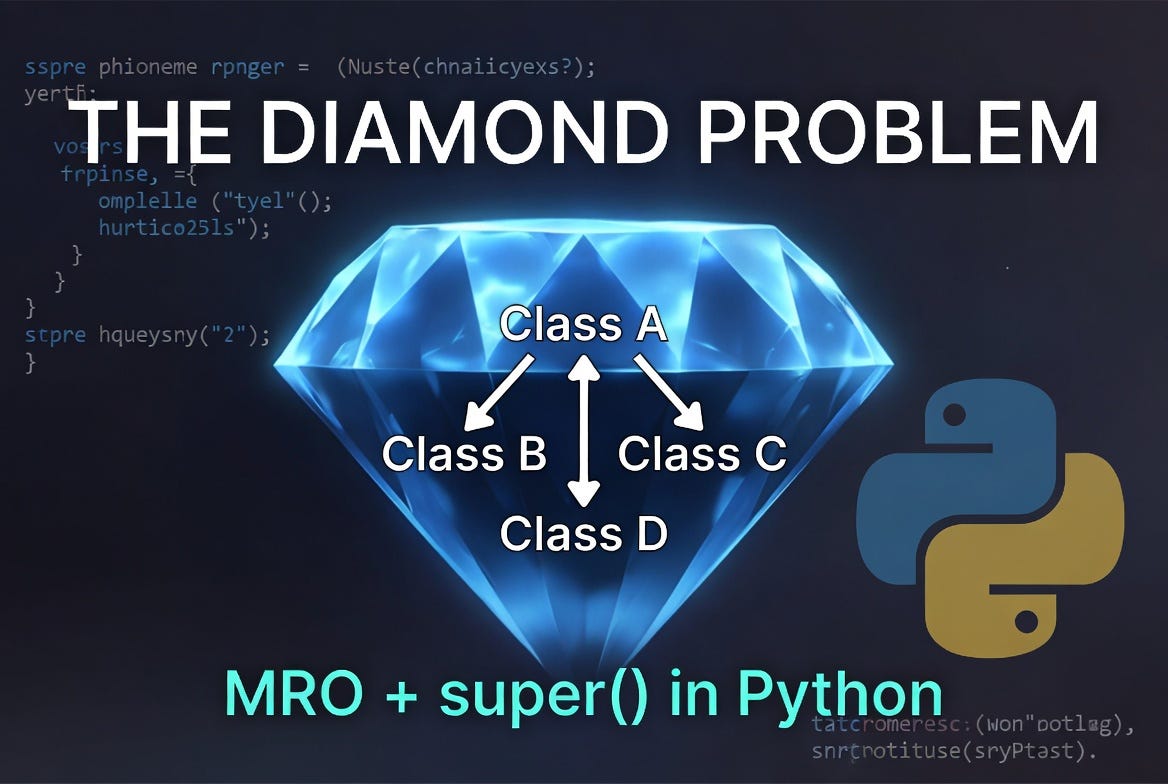
How Python Handles the Diamond Problem in Multiple Inheritance
### Understanding the Diamond Problem
The Diamond Problem—sometimes called the “Deadly Diamond of Death”—is a well‑known complication in programming languages that allow multiple inheritance. It appears when a subclass inherits from two parent classes that both descend from a common ancestor, creating a diamond‑shaped inheritance diagram.
Picture this structure:
- **Class A** is the topmost base class.
- **Class B** and **Class C** each inherit from **A**.
- **Class D** inherits from both **B** and **C**.
If **A** defines a method or attribute, **D** now has two separate inheritance paths to reach it: one through **B** and another through **C**. This raises a clear question: which version should **D** actually use? Should it get two copies of **A**? What happens if **B** and **C** override the same method in different ways?
The Diamond Problem reveals the tension between the flexibility of multiple inheritance and the need for predictable, unambiguous behavior. Some languages avoid the issue entirely, while others provide specific resolution mechanisms.
#### Visualizing the Diamond
```
A
/ \
B C
\ /
D
```
In languages such as C++, without special handling, an instance of **D** would contain two separate **A** sub‑objects: one inherited via **B** and one via **C**. That leads to duplicated data, extra memory usage, and ambiguous method lookups.
### How C++ Demonstrates the Problem
C++ fully supports multiple inheritance and clearly exhibits the issue:
```cpp
class A {
public:
void foo() { std::cout << “A::foo\n”; }
};
class B : public A {
public:
void foo() { std::cout << “B::foo\n”; }
};
class C : public A {
public:
void foo() { std::cout << “C::foo\n”; }
};
class D : public B, public C {};
int main() {
D d;
d.foo(); // Error: ambiguous call to foo()
return 0;
}
```
Even if **B** and **C** do not override `foo()`, the call remains ambiguous because two copies of **A** exist inside **D**.
C++ solves this with *virtual inheritance*:
```cpp
class B : virtual public A { ... };
class C : virtual public A { ... };
```
With virtual inheritance, **D** shares a single **A** instance, effectively flattening the diamond. However, this approach adds complexity to object layout, constructor initialization, and runtime performance.
### Why Many Languages Avoid Multiple Class Inheritance
Because of the Diamond Problem, languages like Java and C# do not allow a class to inherit from more than one concrete class. A class may extend only a single superclass but can implement any number of interfaces. This design choice simplifies the language and removes ambiguity, though it sacrifices some expressiveness.
Java 8 later introduced *default methods* in interfaces, which brought back a limited form of the diamond problem. When two interfaces supply the same default method, the implementing class must explicitly override it to resolve the conflict.
### Python’s Elegant Approach: C3 Linearization and MRO
Python fully supports multiple inheritance but handles the Diamond Problem cleanly using the **C3 linearization algorithm**. This algorithm turns any inheritance graph into a single, consistent linear sequence called the **Method Resolution Order (MRO)**.
In Python 3, every class implicitly inherits from `object`, making all classes “new‑style.” The MRO guarantees:
- Each ancestor appears exactly once.
- The order respects the left‑to‑right declaration of base classes.
- The result is *monotonic* (the order is consistent across all subclasses).
You can inspect the MRO of any class:
```python
class A: pass
class B(A): pass
class C(A): pass
class D(B, C): pass
print(D.__mro__)
# Output:
# (<class ‘__main__.D’>, <class ‘__main__.B’>, <class ‘__main__.C’>, <class ‘__main__.A’>, <class ‘object’>)
```
For **D**, the MRO is: **D → B → C → A → object**
This linear order removes any ambiguity. When you call a method on an instance of **D**, Python searches the classes in that exact sequence until it finds the method.
#### MRO in Action with the Diamond Problem
```python
class A:
def method(self):
print(”A”)
class B(A):
def method(self):
print(”B”)
super().method()
class C(A):
def method(self):
print(”C”)
super().method()
class D(B, C):
def method(self):
print(”D”)
super().method()
d = D()
d.method()
```
Output:
```
D
B
C
A
```
Thanks to the MRO, **A** is called only once, even though it is a shared ancestor. The C3 algorithm ensures a consistent, duplication‑free order.
If you change the inheritance to `class D(C, B):`, the MRO becomes **D → C → B → A → object**, and the method execution order changes accordingly.
### How the C3 Linearization Algorithm Works
C3 linearization follows three main rules:
1. A class always appears before its ancestors.
2. The declared order of base classes (left to right) is preserved.
3. **Monotonicity**: If a class appears before another in any parent’s MRO, that order must hold in the child’s MRO as well.
The algorithm recursively merges the MROs of all base classes while respecting these constraints. If no consistent order can be found, Python raises a `TypeError` at class creation time, preventing problematic hierarchies.
This is a major improvement over Python 2’s old‑style classes, which used a simpler depth‑first, left‑to‑right search that could visit base classes multiple times and produce inconsistent results.
### The Role of `super()` in Multiple Inheritance
`super()` is the tool that makes cooperative multiple inheritance practical in Python. Contrary to a common misconception, `super().method()` does **not** necessarily call the direct parent class. Instead, it calls the *next* class in the current object’s MRO.
This behavior allows different classes to collaborate smoothly in diamond or complex hierarchies. In the earlier example, when `D.method()` calls `super().method()`, it invokes `B.method()`. Inside `B`, `super()` moves to the next class in the MRO, which is `C`, and so on, until `A` is reached.
#### Cooperative `__init__` Using `super()`
One of the most important uses of `super()` is in constructors. Here is the recommended pattern:
```python
class Vehicle:
def __init__(self, **kwargs):
print(”Vehicle initialized”)
self.wheels = kwargs.get(’wheels’, 4)
super().__init__(**kwargs)
class Flyable:
def __init__(self, **kwargs):
print(”Flyable initialized”)
self.wings = kwargs.get(’wings’, 2)
super().__init__(**kwargs)
class FlyingCar(Vehicle, Flyable):
def __init__(self, **kwargs):
print(”FlyingCar initialized”)
self.max_altitude = kwargs.get(’max_altitude’, 1000)
super().__init__(**kwargs)
car = FlyingCar(max_altitude=5000)
```
MRO: **FlyingCar → Vehicle → Flyable → object**
All three `__init__` methods execute exactly once, in MRO order. Each class forwards any unused keyword arguments via `**kwargs`, ensuring cooperation even when different classes expect different parameters.
### Best Practices for Multiple Inheritance in Python
- Keep inheritance hierarchies shallow – ideally no more than two or three levels deep.
- Prefer composition over deep inheritance whenever possible.
- Always use `super()` for cooperative behavior instead of hard‑coded parent calls.
- Use `**kwargs` generously in `__init__` and other methods that may be mixed in.
- Inspect the MRO frequently during development with `Class.__mro__` or `Class.mro()`.
- Design classes to be good citizens in multiple inheritance scenarios (mixins are perfect for this).
- Avoid mixing `super()` with explicit parent calls in the same hierarchy.
### Common Pitfalls
- Forgetting to call `super()` in one of the classes breaks the chain for all subsequent classes.
- Not forwarding `**kwargs` causes `TypeError` when unexpected keyword arguments are passed.
- Assuming the MRO follows a simple left‑to‑right order without actually checking it.
- Creating inheritance graphs that C3 cannot linearize, leading to a `TypeError`.
### Why Python’s Approach Is Powerful
By combining C3 linearization (for a deterministic MRO) with the dynamic `super()` proxy, Python turns the traditionally troublesome Diamond Problem into a manageable and elegant feature. Developers can safely use mixins, trait‑like patterns, and multiple inheritance without the ambiguity that plagues many other languages.
This system rewards careful design. When used properly, multiple inheritance in Python becomes expressive and maintainable. When misused, the language actively warns you through MRO inconsistencies or runtime errors.
In modern Python development, understanding MRO and `super()` is essential for working with large frameworks, GUI toolkits, ORMs, and any codebase that combines behaviors from multiple sources.
Mastering these concepts helps you write cleaner, more reusable code while avoiding the classic pitfalls of object‑oriented design. The Diamond Problem, once feared, becomes just another solved challenge – thanks to Python’s thoughtful language design.
## Appendix:
While the main article explains the Diamond Problem, C3 linearization, and the use of `super()`, several related topics and practical techniques are worth exploring. This appendix introduces concepts that extend or complement the core discussion.
### 1. Mixin Classes: A Design Pattern That Embraces Multiple Inheritance
Mixins are small, focused classes that provide specific, reusable behavior. They are not meant to stand alone but to be combined with other classes. A well‑designed mixin:
- Typically has no `__init__` of its own, or its `__init__` cooperates via `**kwargs`.
- Does not call `super()` expecting a specific base class – it just passes control along.
- Often adds methods or properties but does not override existing ones unless absolutely necessary.
Example:
```python
class ToDictMixin:
def to_dict(self):
return {k: v for k, v in self.__dict__.items() if not k.startswith(’_’)}
class JsonMixin:
def to_json(self):
import json
return json.dumps(self.to_dict())
class Person(ToDictMixin, JsonMixin):
def __init__(self, name, age):
self.name = name
self.age = age
p = Person(”Alice”, 30)
print(p.to_json()) # {”name”: “Alice”, “age”: 30}
```
Mixins are a powerful, safe way to use multiple inheritance because they add orthogonal behaviors without creating deep, ambiguous hierarchies.
### 2. Abstract Base Classes (ABCs) and Multiple Inheritance
Python’s `abc` module allows you to define abstract methods that subclasses must implement. When used with multiple inheritance, ABCs help enforce interfaces across disparate hierarchies.
```python
from abc import ABC, abstractmethod
class Drawable(ABC):
@abstractmethod
def draw(self):
pass
class Clickable(ABC):
@abstractmethod
def on_click(self):
pass
class Button(Drawable, Clickable):
def draw(self):
print(”Drawing button”)
def on_click(self):
print(”Button clicked”)
```
Even if `Drawable` and `Clickable` both inherit from `ABC`, Python’s MRO handles the diamond cleanly. ABCs also support *virtual subclasses* via `register()`, but that’s beyond the scope here.
### 3. Debugging MRO Issues: Tools and Techniques
Beyond printing `__mro__`, you can:
- Use `Class.mro()` to get the same result as a list.
- Visualise the inheritance graph with `graphviz` or simple ASCII diagrams.
- Temporarily add `print(f”Entering {self.__class__.__name__}.method”)` inside methods to trace execution.
- Use `inspect.getmro(Class)` from the `inspect` module.
For large frameworks, the `mro` method of a class can be overridden (though rarely recommended) to customise resolution – but this breaks C3 monotonicity and is generally a bad idea.
### 4. Using `super()` with Class Methods and Static Methods
`super()` works inside class methods and static methods as well, but with subtle differences:
- Inside a `classmethod`, `super()` returns a *bound* proxy that calls the next class’s version of the class method, passing the subclass as the first argument.
- Inside a `staticmethod`, `super()` works similarly but without automatic argument passing.
Example:
```python
class A:
@classmethod
def info(cls):
print(f”A.info called from {cls.__name__}”)
class B(A):
@classmethod
def info(cls):
print(f”B.info start”)
super().info()
print(f”B.info end”)
class C(B):
@classmethod
def info(cls):
print(f”C.info start”)
super().info()
print(f”C.info end”)
C.info()
# Output:
# C.info start
# B.info start
# A.info called from C <-- note: cls is C, not A
# B.info end
# C.info end
```
This pattern is useful for cooperative initialisation or logging across a class hierarchy.
### 5. Multiple Inheritance with Data Classes
Python’s `@dataclass` decorator can be combined with multiple inheritance, but you must be careful about field order and `__init__` generation. The dataclass MRO merges fields from all parent dataclasses, but if two parents have a field with the same name, a `TypeError` is raised.
```python
from dataclasses import dataclass
@dataclass
class Person:
name: str
@dataclass
class Employee:
employee_id: int
@dataclass
class Manager(Person, Employee):
department: str
m = Manager(name=”Bob”, employee_id=42, department=”IT”)
```
If both `Person` and `Employee` defined a field named `id`, conflict would occur. The solution is to rename fields or use composition.
### 6. Composition as an Alternative to Multiple Inheritance
Whenever multiple inheritance becomes too complex, consider *composition*: give a class instances of other classes as attributes, and delegate method calls to them.
```python
class Logger:
def log(self, msg):
print(f”LOG: {msg}”)
class Notifier:
def notify(self, msg):
print(f”NOTIFY: {msg}”)
class Service:
def __init__(self):
self.logger = Logger()
self.notifier = Notifier()
def do_work(self):
self.logger.log(”Working”)
self.notifier.notify(”Work done”)
```
Composition avoids the Diamond Problem entirely and often leads to more testable, flexible designs. It’s the “Favour composition over inheritance” principle in practice.
### 7. The `__mro_entries__` Special Method (Advanced)
Python 3.7 introduced `__mro_entries__` (used by `types.UnionType` and others) to allow a class to substitute itself with a different set of base classes when used in an inheritance list. For example, writing `class D(A, B, C):` could, in theory, be intercepted. This is an advanced, rarely used hook, but it’s part of Python’s metaprogramming toolkit for frameworks.
### 8. Performance Notes on MRO Lookup
Method lookup in Python follows the MRO and is cached per class. Once a class is created, method resolution is fast (a dictionary lookup). However, constructing complex inheritance hierarchies with many base classes increases the size of the MRO and can slow down class creation slightly. For most applications, the overhead is negligible. The real cost is in developer understanding, not CPU cycles.
---